
Running a small business is a lot of pressure. But, what if 110 million people were watching you everyday like at the Super Bowl? This is the type of stress that businesses face when they advertise by spending $3M for a 30-second Super Bowl commercial.
For some consumers, the commercials are a very popular part of the event. Super Bowl ads have produced many breakthrough moments in television and many more bombs. There are memorable commercials from the 2010 Super Bowl like Betty White for Snickers and the Old Spice Man, and 2011 Super Bowl's Doritos. But there have been many more horrible ads like Pets.com sock puppet.
So without spending millions of dollars, what can your business learn by watching Super Bowl commercials?
1. Bring a cliché to life (Snickers). The advantage of cliché’s is that everyone immediately "gets" them. The danger is in having your marketing become part of the cliché itself. Snickers brought the cliché of your friends comparing your effort on the football field to that of an old woman by showing Betty White on the football field. The tagline - "you are not you when you're hungry." It was a moment most guys can relate to and used humor to bring home their overall strategic message for the candy bar ... which is that it conquers hunger.
2. Make your competition the bad guy (Comcast & Teleflora) - Comcast had an ad featuring an overeager Verizon rep ready to bring out the heavy machinery to rip up your front lawn in an effort to install their new Fios lines. Teleflora poked fun for the second year in a row at their competitors who send flowers in a box. What both ads managed to do is give the viewer a very clear portrayal of the bad guy (ie - their competition) and therefore positioned themselves as the far better choice as a result. A relatively straightforward marketing tactic that is applicable no matter what your marketing budget happens to be.
3. Tap the cultural zeitgeist (Audi) - For Audi's ad touting their new A3 (a "green" environmentally friendly car), they showed a vision of a world where the "green police" were a real group. For anyone who has had a passionately believer in all things green as a friend or colleague, this concept of the green police is very recognizable. With the increasing attention from all angles (the media, your friends, your kids, etc.) on being green, all you need to do is make one simple choice to get the A3 and you'll be travelling in the faster green lane on the road and give yourself a "get out of jail free card" in relation to the environment. A powerful message.
4. Be the statement your customer makes. (Dodge & Flo TV) - I wrote on my own blog this week about the recurring theme in this year's Super Bowl of the "emasculated man" who is portrayed as having little of his own will left after giving up much of it to his wife/girlfriend. This is, of course, a caricature of men, however the more interesting marketing strategy is that both Dodge and Flo TV positioned their products as the "last stand" that a man can make to keep his manhood. In other words, buy a subscription to our service or get our car and you will be a man again. See how the power of making a big statement works?
5. Appeal to your customer's ego (Dove & Cars.com) - In stark contrast to the concept of the ads in #4, both Dove and Cars.com presented a much more positive portrayal of today's man. Dove pitched their product to men who are "comfortable in their own skin" and Cars.com used a child prodigy/man-of-the-world character to show how even renaissance men need help with buying a new car. The lesson from both was that sometimes you can also use the ideal vision of themselves that your customers have to position your product as the enlightened choice.
6. Don’t risk everything at once. In small business marketing, it is far safer and more effective to spread your bets by testing many different marketing methods. Homeaway.com took a big risk for a small company running their second Super Bowl ad this year. For your small business, it is far more effective to take patient interim steps. After your company has learned what works and doesn’t work in your marketing campaign, plot the next step. With limited capital, small businesses can’t afford the risk of a “one and done” strategy.
7. Track how the marketing tactic performed. Most companies have a variety of things they do to promote their business. Spending money on marketing is worthless unless your business knows what worked and what did not work. It is essential to get feedback on all aspects of your campaign. It is simple with today’s technology to ask the consumer in the targeted segment to go to your website or use a social media tool to judge results. The Ford Focus commercial encouraged the audience to cheer on their team online and “Watch, Compete, and Win."
Showing posts with label Advertising. Show all posts
Showing posts with label Advertising. Show all posts
Thursday, February 2, 2012


Thursday, October 27, 2011
Advertising Is A Poison -And We're Hooked On It
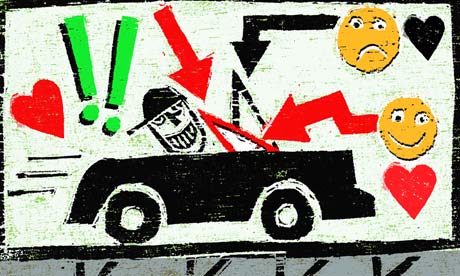
We think we know who the enemies are: banks, big business, lobbyists, the politicians who exist to appease them. But somehow the sector which stitches this system of hypercapitalism together gets overlooked. That seems strange when you consider how pervasive it is. In fact you can probably see it right now. It is everywhere, yet we see without seeing, without understanding the role that it plays in our lives.
I am talking about the industry whose output frames this column and pays for it: advertising. For obvious reasons, it is seldom confronted by either the newspapers or the broadcasters.
The problem was laid out by Rory Sutherland when president of the Institute of Practitioners in Advertising. Marketing, he argued, is either ineffectual or it "raises enormous ethical questions every day". With admirable if disturbing candour he concluded that "I would rather be thought of as evil than useless." A new report by the Public Interest Research Centre and WWF opens up the discussion he appears to invite. Think of Me as Evil? asks the ethical questions that most of the media ignore.
Advertising claims to enhance our choice, but it offers us little choice about whether we see and hear it, and ever less choice about whether we respond to it. Since Edward Bernays began to apply the findings of his uncle Sigmund Freud, advertisers have been developing sophisticated means of overcoming our defences. In public they insist that if we become informed consumers and school our children in media literacy we have nothing to fear from their attempts at persuasion. In private they employ neurobiologists to find ingenious methods of bypassing the conscious mind.
Pervasiveness and repetition act like a battering ram against our minds. The first time we see an advertisement, we are likely to be aware of what it's telling us and what it is encouraging us to buy. From then on, we process it passively, absorbing its imagery and messages without contesting them, as we are no longer fully switched on. Brands and memes then become linked in ways our conscious minds fail to detect. As a report by the progressive thinktank Compass explains, the messages used by advertisers are designed to trigger emotional rather than rational responses. The low-attention processing model developed by Robert Heath at the University of Bath shows how, in a crowded advertising market, passive and implicit learning become the key drivers of emotional attachment. They are particularly powerful among children, as the prefrontal cortex – which helps us to interpret and analyse what we see – is not yet fully developed.
Advertising agencies build on this knowledge to minimise opportunities for the rational mind to intervene in choice. The research company TwoMinds, which has worked for Betfair, the drinks company Diageo, Mars, Nationwide and Waitrose, works to "uncover a layer of behavioural drivers that have previously remained elusive". New developments in neurobiology have allowed it to home in on "intuitive judgments" that "are made instantaneously and with little or no apparent conscious effort on the part of consumers – at point of purchase".
The power and pervasiveness of advertising helps to explain, I believe, the remarkable figure I stumbled across last week while reading the latest government spreadsheet on household spending. Households in the UK put an average of just £5.70 a week, or £296 a year, into savings and investments. Academic research suggests a link between advertising and both consumer debt and the number of hours we work. People who watch a lot of advertisements appear to save less, spend more and use more of their time working to meet their rising material aspirations. All three outcomes can have terrible impacts on family life. They also change the character of the nation. Burdened by debt, without savings, we are less free, less resilient, less able to stand up to those who bully us.
Invention is the mother of necessity. To keep their markets growing, companies must keep persuading us that we have unmet needs. In other words, they must encourage us to become dissatisfied with what we have. To be sexy, beautiful, happy, relaxed, we must buy their products. They shove us on to the hedonic treadmill, on which we must run ever faster to escape a growing sense of inadequacy.
The problem this causes was identified almost 300 years ago. In Robinson Crusoe, published in 1719, the hero remarks: "It put me to reflecting, how little repining there would be among mankind, at any condition of life, if people would rather compare their condition with those that are worse, in order to be thankful, than be always comparing them with those which are better, to assist their murmurings and complainings." Advertising encourages us to compare ourselves with those we perceive to be better off. It persuades us to trash our happiness and trash the biosphere to answer a craving it exists to perpetuate.
But perhaps the most important impact explored by Think of Me As Evil? is the one we discuss the least: the effect it has on our values. Our social identity is shaped by values which psychologists label as either extrinsic or intrinsic. People with a strong set of intrinsic values place most weight on their relationships with family, friends and community. They have a sense of self-acceptance and a concern for other people and the environment. People with largely extrinsic values are driven by a desire for status, wealth and power over others. They tend to be image-conscious, to have a strong desire to conform to social norms and to possess less concern for other people or the planet. They are also more likely to suffer from anxiety and depression and to report low levels of satisfaction with their lives.
We are not born with our values: they are embedded and normalised by the messages we receive from our social environment. Most advertising appeals to and reinforces extrinsic values. It doesn't matter what the product is: by celebrating image, beauty, wealth, power and status, it helps create an environment that shifts our value system. Some adverts appear to promote intrinsic values, associating their products with family life and strong communities. But they also create the impression that these values can be purchased, which demeans and undermines them. Even love is commingled with material aspiration, and those worthy of this love mostly conform to a narrow conception of beauty, lending greater weight to the importance of image.
I detest this poison, but I also recognise that I am becoming more dependent on it. As sales of print editions decline, newspapers lean even more heavily on advertising. Nor is the problem confined to the commercial media. Even those who write only for their own websites rely on search engines, platforms and programs ultimately funded by advertising. We're hooked on a drug that is destroying society. As with all addictions, the first step is to admit to it.
Tuesday, September 27, 2011
6 Tips to Improve the Effectiveness of Your Banner Ads

The average click through rate from banner advertising on the internet is 2.1%, says Brittney Smith, Marketing Analyst for the 60 Second Marketer. You want viewers to not only see the ad, but also to interact with it. In order to boost the effectiveness of your online advertising, take a look at these six tips to help get you the response you’re looking for:
1. Make it quick. Gaining the attention of the viewer occurs within the first few seconds they glance through the webpage. The message needs to be kept as simple and concise as possible. Shorter ads will be easier for the consumer to remember.
2. Location, Location. Your banner will fade into the background of the page if the message is not relevant to the audience viewing it. Targeted placements are crucial if you want to reach people who will be receptive to your message. Be selective where you buy ad space. A successful response does not include a 16-year-old boy clicking through on your banner ad directed towards mothers.
3. Intrigue your audience. Using simple animation can increase your response rates by 25%. Adding a bit of creativity to the ad can go a long way. If you have the proper resources available, consider using rich media, with sound and other special effects, to set your ads apart from the rest of the clutter. Make sure the animation or images are useful, not annoying, to consumers. “Tell me and I will forget, show me and I may remember, involve me and I’ll understand.”
4. Develop follow-through mechanism. If you are looking for a specific action from your users, be sure to create follow-through mechanisms that lead the consumer where you want them to go, whether that is the company’s homepage or a landing page specific to the banner.
5. Test your banner ad. The most important factor in the effectiveness of a banner ad is to test and optimize across several fronts. The performance of your banner ad can vary greatly from one design to another along with the size and placement within the website. Be sure to constantly monitor the ad once it has been placed.
6. Keep consistent with your campaign. Your banner ads should not simply be a one off, but be integrated with your overall marketing campaign. Banner ads need to support and tie in with your other marketing such as email and direct mail.
Banner ads can be a useful addition to your ad campaign, but a futile venture if they do not expose the brand to users or drive them to action. When creating banners, consider the users’ interests and what you want the end goal to be. The performance of your banner ad can always be improved through revision and if used properly can be an effective tool. Banner ads can offer a layer of interactivity to the consumer that they do not get from traditional media. Users can spend minutes interacting with these ads, so make each second count!
Tuesday, September 6, 2011
Advertisers’ Cookies: 'Do Not Track' Goes Live, Gets Slammed

Third-party advertisers regularly use information gathered from your browsing and buying habits to target you with relevant ads -- think, for instance, of how many times you've visited an online retailer, then noticed the retailer's banner ads following you around the Internet. That's raised some privacy concerns among many users uncomfortable with advertisers knowing their habits in such detail.
The Interactive Advertising Bureau, whose members are responsible for 86% of online advertising, has proposed a self-regulatory step in which advertisements would contain a "do not track" button as a means of disclosing the tracking mechanism and giving users the ability to opt out. Monday was the deadline for the members to join the program and comply with the rules.
Privacy advocates aren't convinced, however.
The advocacy group Consumer Watchdog said Monday that the "Advertising Option Icon" doesn't qualify as a "do not track" feature, as it allows users only to opt out of being tracked by the companies participating in the program. Also of concern was the fact that the opt-out action would remain in place only until the user cleared his or her tracking cookies -- something many privacy-conscious people do on a regular basis.
Perhaps the biggest objection, though, is that any self-regulating system will be ineffective in the absence of actual government enforcement.
"This industry program is another example of the failure of self-regulation to protect consumers from unwanted monitoring of every move they make on the internet and their mobile devices," said Carmen Balber, Washington director for Consumer Watchdog, in a statement. "Action by Congress and the FTC to require a 'Do Not Track Me' option is crucial for consumers to gain control over their own information."
It's not the first time we've heard that refrain in reference to Internet tracking. Earlier this year, when Microsoft's Internet Explorer joined Mozilla's Firefox in implementing a tool that would let users automatically disable tracking, we noted that both browsers rely on voluntary compliance by the advertisers.
The question, then, is whether such mandatory compliance will take place. When the Federal Trade Commission proposed a "do not track" option back in December, it said self-regulation could be sufficient. But its tune may be changing: Earlier this month, an FTC commissioner expressed his belief that more compulsory regulations may be necessary to force advertising companies to disclose their practices and give consumers a way to opt out.
If the industry's new attempt at self-regulation does indeed prove ineffective, those calls could grow louder.
Thursday, August 25, 2011
NASCAR and the Pentagon: As American as Apple Pie
 The battle over spending continues to rage on Capitol Hill and while Republicans are keen to take an axe to the budget, one interesting item was spared: The Army’s sponsorship of NASCAR. The House gave the green light for that sponsorship to continue, rejecting an amendment that would have blocked the Pentagon from using taxpayer dollars for NASCAR ads.
The Army spends more than $7 million a year to sponsor NASCAR Sprint Cup driver Ryan Newman and several million more as part of a partnership with NASCAR. It says the prominent ads on the car and presence at the track help attract recruits.
Over the last decade each branch of the military has had a partnership with NASCAR. But now just the Army, Air Force and National Guard continue to sponsor teams - the Marines, Navy and Coast Guard dropped their own NASCAR sponsorships in recent years.
Perhaps the ads are working. Military recruitment is surging - the waiting lists to sign up are currently longer than they have been in recent years which could be a result of several factors: the still-struggling economy, high unemployment rate and the post-9/11 GI Bill, that pays for education and housing for family and service members who have served at least 90 days and were honorably discharged.
Recently NASCAR revamped its business and marketing model to reach new and younger audiences hoping to increase track attendance and TV ratings. NASCAR's audience had steadily eroded over the last four years due to a variety of circumstances, not the least of which was alienating its longtime, hard-core fans with a variety of changes: later starts to appease West Coast viewers; altering its rules that made for safer, albeit less exciting racing; as well as a tepid economy, rising ticket prices and skyrocketing gas prices.
The new integrated-marketing communications department has focused a good part of its attention to the critical 18- to 34 year-old demographic, using social media to help organize college viewing parties; developing a dedicated youth website; and promoting young drivers such as surprise Daytona 500 winner Trevor Bayne (age 20), Joey Logano (21) and, starting with the Nationwide Series Kroger 200 race this Saturday, action sports star Travis Pastrana (27). It is also expanding its outreach for branded entertainment in TV, films and music videos, and taking a deeper dive into the burgeoning Hispanic market with the creation of more Spanish-language content.
The Army saw an opportunity to leverage NASCAR’s strategy into a recruiting tool so it sank some serious advertising dollars into drag racing. They wanted a driver to be all he could be for them, personable with a heavy foot on the gas, as passionate for what the Army represented as he was for squeezing every nano-second out of his Top Fuel dragster. The Army’s sponsorship places an impetus among young fans that sharpens the focus and dedication, the idea being that a military branch active in a foreign theater provides more of a motivation than, say, selling auto parts.
The Army has maintained a presence in NASCAR since 2000, through direction from Congress itself. NASCAR, of course, is one of the most popular spectator sports in America, and if the Army wants to attract more people, then—stereotypes aside—there aren’t many better places than stock car racing.
Tuesday, June 7, 2011
Boomer Advertising: Proof That Advertising is "Dumb"

This amounts to a reversal in thinking that took hold during the 1960s, when advertisers first started aiming for baby boomers, the largest segment of the United States population. But the reasons for the shift are not just demographic, they are economic. As a result of the recent recession, unemployment rates for younger age groups have been far higher than those for older Americans. Financially, the disparity is similar. According to the Bureau of Labor Statistics, those people aged 45 to 54 and 55 to 64 had the highest median weekly earnings of any age segment in the United States. The older demographic has buying power and discretionary income to spend. Boomers know they’ll most likely live longer than their parents did, and they plan to enjoy it. They love to travel, they engage in various leisure activities and they want to be well and energetic. Many of these folks are ready to spend money in their “Golden Years” in order to feel young and vibrant.
This isn’t just a marketing issue; it’s a cultural and social issue as well. On the occasions that they are marketed to, the advertising is usually condescending. Rather than increasing their value and esteem, once past the age of 50 older Americans are depicted as stale and out-of-sync. That is not their self-image. For decades, television has been the most determined proselytizer on behalf of the premium value of reaching consumers aged 18 to 49. In the 1960s, ABC found itself hopelessly uncompetitive with CBS and NBC in what was then the standard ratings measurement, total households. So the network adopted a strategy to appeal to younger viewers with programs like “Batman,” “Shindig,” and “Mod Squad.”
The idea caught on, and even as the boomer generation grew older, advertisers continued to court younger viewers — first on the theory that they had not yet established brand loyalty, then because they were harder to reach than mature viewers who watched far more television. Since then, all advertising sales have been based on two main groups, those people aged 18 to 49, and those 25 to 54. Once viewers reached 55, they were considered all but valueless.
In the last decade, NBC has been a central force in pushing that view, as the home of youth-oriented hits like “Friends” and “The Office.” But Alan Wurtzel, the president of research for NBC Universal, initiated a study last year into a group he labeled “alpha boomers,” the leading edge of the baby boom generation, which is now turning 65. For companies to avoid shifting advertising and marketing attention toward older Americans is “a big mistake,” he said. “You risk not only growth, but at some point you risk your brand.”
Mature consumers also seem to be spending on categories not traditionally associated with older people. NBC’s study of those people 55 to 64 showed that they spent more than the average consumer on categories like home improvement, large appliances, casual dining and cosmetics.
They have also become heavy spenders on electronics and digital devices. The study also showed that members of the 55-to-64 age group were just as likely as those ages 18 to 34 to have high-definition televisions, digital video recorders and broadband service.
The median age for audiences for every broadcast network has moved upward since 2006. NBC has moved to 50.1, from 48.5; ABC increased to 52.3, from 47.4. Fox, always the youngest network, aged to 45.4, from 41.5. CBS began at 53 and is now at a median age of 56.
“American Idol,” once considered the hot show for young people, finished its first season 10 years ago with a median age of 32.1. This season, its median age is 47.2. ABC’s biggest hit, “Dancing with the Stars” has a large complement of 50-plus viewers.
Brent Bouchez, the founder of Agency Five-0, which caters to older consumers, said the biggest misconception about the group was that older Americans wanted to be younger. He cited the example of Ketel One, a vodka brand that he drank before it changed its advertising to aim for a younger audience. Mr. Bouchez said he stopped asking for the vodka at bars.
“I don’t want to look like the 53-year-old who’s trying to look 30,” he said.
Friday, April 22, 2011
How to Examine Your Failed Ads and Make Them Work Next Time

At its basis, advertising is simple.Incredibly simple. Just deliver to the public your offer to sell something. The public’s reaction, though, is not as uncomplicated as "I’ll buy" or "I won’t buy." Actual responses range from absolutely no interest on the unsuccessful end of the response continuum to, on the successful end, people pounding on the door because the sign says the store opens at 8:30, and it’s now 8:32.
Why do most ads produce results somewhere between these extremes? There are 10 factors that could cause your advertising to produce disappointing results. The first two factors involve your offer:
Cause #1: Did anyone want the stuff you had to offer?
Ideally, businesses would identify and research a market, then develop what the customer really wants. In the real world, manufacturers create, and retailers stock, things they believe people will want. Sometimes, they’re wrong. When those retailers say to the world, "Hey, come and buy our diamonelle-encrusted left-handed can openers," people don’t say, "I don’t want any, thank you." They don’t say anything. They care so little about the offering, they don’t even notice the ad, and won’t remember ever seeing or hearing it.
Cause #2: Did you offer what people needed when they were most likely to need it?
Think seasonality. Swimsuits don’t sell well in November. Halloween candy won’t get much attention in April.
The next four factors involve the content of your message:
Cause #3: Did your ad snag shoppers' attention? Were you able to hold that attention long enough to deliver your offer?
There are three broad categories of advertising communication: entertainment, information, and engagement.
1. Entertaining ads can work, if there’s a direct connection between entertainment and the one thought you’re trying to plant in the minds of shoppers. In far too many ads the entertainment is not relevant to the advertising message.
2. Most ads offer information. Unfortunately, it’s about the advertiser. Good ads are about the customer. Instead of "We have a huge selection of clean, late model cars to fit any budget," try "Admit it, you’re going to like the way people look at you when you drive a classic Porche."
3. Engagement requires the shopper to pay close attention to, and consciously consider, the content of your advertising. Unless that shopper is ready to purchase, catching her with a marginally different offer won’t elevate your ad to consideration status.
Say the same things your competitors do, and rest assured that most shoppers will ignore you. But say something salient, something highly meaningful, and watch the difference.
Cause #4: Did you engage? Did you actually say anything worth remembering?
Too many ads are tedious, dreary, boring, and monotonous. Are yours? Just because you have a lot to say doesn’t mean your audience will sit still and pay attention. Nobody gets emotionally involved in a laundry list of brand names, sale items, or the number of collective years of your staff’s experience. The most you can expect of any ad is to convey one single, compelling idea. Find that one idea, and express it.
Cause #5: Did your ad persuade? Did you extend an invitation to buy (a call to action)?
Sometimes we notice a highly creative and entertaining ad campaign, only to find out later that the advertiser lost market share while the campaign ran. The "¡Yo quiero Taco Bell!" chihuahua, "Joe Isuzu," and Old Spice’s "The Man Your Man Could Smell Like" campaigns come to mind. High entertainment value. Precious little persuasion.
Entertainment aside, shoppers are skeptical. No matter how truthful any claim you make in your ad might be, people don’t automatically believe you. That process which falls between demonstrating your evidence, and leading them to agree with your claim, is persuasion.
Cause #6: Did your ad complement your image?
People who project different personalities, depending on which group of people they’re associating with, are not trusted. Without trust, you don’t have customers.
Like people, companies have personalities, which are a critical part of their brand. Advertising is an extension of that brand. If it’s loud, insulting, self-centered, annoying, or otherwise offensive, people will assume your business is organized around those qualities.
What is it that people know about you? What is your professional reputation? What is your image among customers? Among non-customers? Do you have an image? How do you know?
The final four causes involve external factors:
Cause #7: Did you choose the right medium? Did you have the right sized ad?
Think of advertising as your cost to acquire customers. Costs per exposure, per thousand, or per rating point only matter indirectly. Media efficiency is calculated by dividing the number of dollars invested by the number of new customers you’ve acquired. Magazines with tiny circulations but active readership may be a great investment. Regional television stations with the highest priced ads in town may also be a great investment.
Until you track the number of new customers each produces, and the average sale of each new customer, you can’t do a meaningful comparison.
Cause #8: Did you schedule your ads at the optimum frequency?
There are two factors which combine to make media impact. One is the size of the ad (in column inches, or seconds, or pixels), and the other is the number of times shoppers read / hear / view it. Exceptionally salient ads may only need one exposure. Most require multiple exposures to the ad before people respond to your offer. Under normal circumstances you’re going to need to run that ad several times.
Cause #9: Did you allow enough time for shoppers to need what you sell?
People eat several times a day. They need new tires every year or two. They buy refrigerators and mattresses maybe once per decade. How many of them are in the market for what you sell at any given time?
Ads for short purchase cycle offerings should pay off quickly. The impact of grocery or restaurant ads can be measured in days. Other products, which have longer purchase cycles require more patience, and more persistence.
Cause #10: Did you start with a clear goal?
What was it you wanted to happen when you bought that advertising which didn’t work? Did you expect to see new faces in your store? Additional referrals? Greater market awareness for your company ("getting your name out there")? Sales increases? Additional goodwill? If you don’t know what you were attempting to accomplish, how can you be sure your advertising DIDN’T work?
Yes, advertising works. We suspect everyone knows that.
A former boss, when told advertising didn’t work, offered to run some free radio ads for the skeptic. He said, "Let me tell you what they’ll say: Free $100 bills at your business." No one ever took him up on it.
Maybe yours is one of those companies which has all of the customers it needs. Congratulations. We envy you. Most every business owner we talk to, however, needs a steady influx of new customers.
Like playing golf or riding a bicycle, there are skills you’ll need to make it work. You weren’t born with the ability to run your own company, but you learned what to do, and when, and why. Likewise, you can develop the ability to profitably advertise that same company. You’ll need to invest a modest budget, commit to some seriously detailed record keeping, and allocate enough time to develop and hone those skills. Thirty minutes a day for the next year will give you the rough equivalent of one semester of Intro to Marketing.
Fortunately, there’s a lot of great information available, and much of it free. If you’re ready to get started, drop us a note and we’ll send you a recommended reading list.
Thursday, March 17, 2011
Advertising vs. Public Relations: When To Use Each One

The application of public relations and the use of advertising are sometimes misunderstood, igniting a series of unanswered questions for companies needing to create awareness for themselves, says Mickie Kennedy, founder of eReleases.com.
When do you use public relations? Why should you advertise? The best answer on both topics is "It depends on what you're trying to accomplish." Use public relations and advertising (and marketing) together as well as separately when the situation calls for it.
Still confused? Don't fret. You're in good company.
Message Control
A distinct difference between PR and advertising is their extent of message control. When, where, and how an advertisement runs is quite controllable. Ad space purchased in the right format (i.e. broadcast, radio, print, online, sky writing, floating barge) means one has inherent control over what messages are communicated.
Conversely, while the process of creating messages through public relations is controllable, what occurs after the message has left the "nest" is often uncontrollable. The most common uncontrollable factor is whether the media view your information as newsworthy. In advertising there is no question whether your information will be publicized-if the check cleared, you're in.
We know what you're thinking. You want control of the message from beginning to end so you've decided that advertising is the way to go. Have you thought about the current shelf life of an advertisement? What about implied endorsement? Costs?
Shelf Life: TV Commercials and the Press Release
Until recently, TV advertisements have had a shorter shelf life than a press release archived on the Internet. For now this is probably still true, but watch out. New Web sites are coming online with nothing but commercial content that would make any ad executive smile. Corporations are also posting their commercials on corporate Web sites to extend the shelf life of their ad dollars.
Obstacles to viewing archived commercials are many. The more common ones include slow Internet connections, lack of installed software for viewing, and unless there is an HTML description about the commercial for search engines to archive, add inability to find a commercial online to the list of obstacles. These barriers are coming down quickly as technology and computer training improve.
Archived press releases and news articles still rank high in terms of Internet longevity. Search engines can locate information (even in PDF format for some) long after the hype of a press release has waned. The major obstacle here is a person without access to the Internet.
Implied Endorsement
No matter how interesting an advertisement might be, it is recognized as a self-serving communication. The only implication here is that someone paid to have a message filtered directly to a consumer. There is no third-party endorsement, no filter before it reaches you.
Public relations affords the credibility of indirect third-party endorsements. This means you are not paying to get advertising placed, but a publication is freely giving space to a story about your company. When the press report about you it is called earned media; and such an endorsement is a powerful tool in shaping public opinion.
Consumers today are far more cynical than previous generations; with only a small percent saying they have a great deal of confidence in advertising messages. Anyone can buy visibility, however PR plays a critical role in sorting out the hype.
Costs
Advertising exposure is often proportional to the amount of money spent on the advertisement. Whether your ad sits on a billboard overlooking the highway or plays during prime time television, advertising will consume your budget faster than a well-positioned, well-written press release.
For small companies, public relations is the better method for direct and personal communication with a target audience. For larger companies with a sufficient budget, advertising along with public relations may be the right combination for success.
Thursday, February 3, 2011
Traffic Jam in Super Bowl

Ad Age reports that BMW North America will return to the game after a decade, seeking to use the Super Bowl as a stage to launch a new slate of cars. General Motors, which had sat the past two games out, is back in with a focus on Chevrolet. Chrysler, the only U.S. automaker to show up in the last Super Bowl broadcast with a single ad for Dodge, is back in and this time wants at least two brands in the game. Audi of America is making its fourth consecutive Super Bowl appearance and will be in the game's first commercial break.
Indeed, many automakers are bouncing back, posting healthy sales results after bankruptcy filings, government bailouts and recalls, and like Mercedes, they have news to share about new models -- in BMW and GM's case, electric car models. It all adds up to car makers heftily contributing to the record sellout of the game. News Corp.'s Fox, which is broadcasting the game, booked 80% of its ad inventory by June, and by October the network announced the Super Bowl was sold out.
Now comes the real challenge: After spending all that money, how do you get your messages to cut through? Since so many car ads look the same, the chance of their being recalled by consumers is low. Most top broadcast-network shows have a car ad in nearly every commercial break, often showing an automobile or truck traveling on an open road or city street while pop music plays in the background.
Making things worse, car makers over the past two years have grown more conservative, trading humor and emotion for retail-oriented messages. Steve Wilhite, who spent 20 years at VW of America and was the client behind Arnold's famous "Drivers Wanted" campaign, describes car advertising these days as "absolute dreck," "mind-numbing" and "uninspiring." Experts say carmakers will now have to work doubly hard to avoid familiar tropes or themes.
To combat the problem, ad-buying agencies representing many top automakers usually ask TV networks not to run ads from competitors during the same commercial break. Even so, these rules only apply to national commercials, and ads from local stations can sometimes run in the same ad pod. Ad buyers with knowledge of automobile marketing have often said that consumers' ability to recall individual car ads gets weakened as more of them air.
One big car advertiser hopes to stand apart from the pack by not joining it. Ford Motor Co. will advertise only during Fox's pre-game coverage, said Matthew VanDyke, director of U.S. marketing communications at Ford.
Thursday, January 27, 2011
Hey, Taco Bell, Where’s the Beef?

Attorney Dee Miles said they had Taco Bell’s “meat mixture” tested and found it contained less that 35 percent beef. The lawsuit does not seek monetary damages, but asks the court to order Taco Bell to be honest in its advertising. Irvine, Calif.-based Taco Bell spokesman Rob Poetsch said the company denies that its advertising is misleading. “Taco Bell prides itself on serving high quality Mexican inspired food with great value. We’re happy that the millions of customers we serve every week agree,” Poetsch said. He said the company would “vigorously defend the suit.”
Jon Andersen with the Andersen Law Firm wrote an article about advertising law. Here’s what Jon wrote:
In a recent reported matter before the Nation Advertising Division of the Council of Better Business Bureaus was an objection to some press releases released by the company, PrintsMadeEasy, Inc. Among other things, the press releases announced that the Business Cards Association of America had given its “annual” award for “Top Business Card Provider” to PrintsMadeEasy.com.
The award was issued by a “blue ribbon panel” that ranks business card providers on their service. The release then went on in some detail about the reasons PrintsMadeEasy.com was selected for the award (as well as a few disparaging remarks about competitor VistaPrint).
As you have probably already guessed, there is no “Business Cards Association of America”! There was absolutely no truth to the claim that any award was issued by such an association, let alone an “annual” award, nor was there a “blue ribbon panel” which ranked business card providers on their service.
Squirming in the face of the enormous falsehoods, PrintsMadeEasy tried to duck by saying that the press releases were really not advertising and furthermore, they (PrintsMadeEasy) did not control the content of the press releases which were prepared and distributed by an outside public relations firm.
Needless to say, NAD wasn’t buying any of that bit of guff and determined that the press release was nothing short of a paid commercial message by the advertiser. No joke! Advertising practices such as this should be hammered, and hammered hard. Here both the company and the PR firm were completely dishonest and deserve any suffering that may have resulted from this activity.
Probably no business is more competitive than food. From white tablecloth restaurants to supermarkets to farmer’s markets, the variety of offerings is mind boggling. So, making a product stand out is no easy task. In the recent past, the move on the part of the large consumer packaged food marketers, the thrust of the pitch seems to have been to involve health benefits.
For a while, the products seemed to focus on their “lack” of bad ingredients, i.e. no fat, low sodium, reduced sugar, etc. If we eat the advertised product, we will reduce our risk of the adverse health effect associated with the product in an unaltered state. And the advertising followed suit, with headline claims on how to lower your cholesterol by simply using the advertised product and, oh by the way, also following a low fat diet. And so it went.
Now, the trend has shifted from what is removed from the product to what has been added for our benefit. It is a world of additives, the “vitamin enriched” products, such as orange juice and even water. And vitamins everyone thought they understood. There is even a chart on most products detailing your daily recommended vitamin level, and the percent of that level a serving of the product delivers.
Then Dannon struck gold with its Activia yogurt. And a new advertising theme was created, “biotics.” Probiotics! Prebiotics! And the theme now is how these ingredients, work with your body’s natural systems (digestive, immune, etc.) to provide health benefits greater than ever.
Of course, advertising, spreading the word on these new ingredients and the health benefits jumps in with both feet, citing clinical studies, test results, statistics and other supportive “scientific” evidence. Many of the claims border on the claims made for products that most reasonable consumers know are not true, the “lose 30 pounds in two weeks with X-Loss” sort of thing. But these are “big-league” companies. So the question is real benefits or just marketing hype? How do we tell?
Ah, a California (where else) law firm is seeking to have a jury tell us. Representing a female named Patricia Wiener (and seeking to have the case expanded to a class action, mostly because there is not much money to be made in one plaintiff), a lawsuit has been filed against Dannon alleging that Ms. Weiner has been damaged because of the deceptive advertising for its DanActive, which duped her into buying the product. The law firm takes great issue with Dannon’s claims of “clinically proven” results. Lesson: Is your claims substantiation evidence court-worthy?
Friday, December 24, 2010
Ads That Go Awry Spark Controversy
Ah, advertising. The 1930s performer Will Rogers famously referred to it as "the art of convincing people to spend money they don't have for something they don't need."
But that time-honored tradition can easily run afoul of the other mandate of the modern advertiser: to amp up the imagery, language or overall shock value of an ad to get your client's product to stand out in a crowded marketplace, says Brett Michael Dykes, a national affairs writer. This year, the clash of these central directives has generated a lot of buzz for some major ad clients — just not the kind that they were hoping for.
Burger King's "The King's Gone Crazy" campaign
 The ad in question features BK's trademark king running frantically through an office building, apparently as an escaped mental patient, pursued by a man dressed in a white lab coat who yells, "Stop that King, he's crazy!" The runaway King proceeds to run through the glass window of a break room to hand a burger over to a woman standing next to a microwave. Then two bow-tied men materialize and subdue him — the clear implication being that they are attendants from a mental hospital. They tell the shocked woman holding the burger that "this King's insane" for giving away "so much beef for $3.99." Smitten with the low price, she replies to one of the attendants, "you're the one who's nuts." "I was stunned. Absolutely stunned and appalled," says Michael Fitzpatrick, executive director for the Arlington-based National Alliance on Mental Illness, one of the nation's largest mental health advocacy organizations. He called the ad "blatantly offensive" and hopelessly retro in its depiction of mental illness, adding that the commercial could lead to further stigmatization, the primary barrier for individuals to seek out treatment. "We understand edgy," Fitzpatrick says. "But this is beyond edgy. Way beyond." David Shern, president and chief executive of Mental Health America in Alexandria, says the ad was "a perfect storm of images and words coming together," comparing it to an advertisement using the word "idiot" while featuring someone who was mentally challenged. Both groups sent letters to Burger King asking that the advertisement be removed.
Mental health organizations have spoken out against ad campaigns in the past, such as Vermont Teddy Bear's 2005 Valentine's product, which featured a "Crazy-for-You" teddy in a straitjacket (because nothing says love like restricted arm movement and claustrophobia). Or a 2007 General Motors commercial in which a robot jumps off bridge after being fired from the assembly line. Some have pointed out that the Burger King ad — which recently ended its scheduled run — was reminiscent of the old "Crazy Eddie" discount electronics store ads that ran in the Northeast for a number of years. The real Crazy Eddie, a man by the name of Eddie Antar, spent a number of years in prison on fraud-related charges. The cheap-burger-slinging King remains on the right side of the law, so far as we know.
POM's "Cheat Death" campaign

You may have heard something in the last few years about pomegranate juice helping you live a longer, healthier life. In the event you haven't, POM Wonderful, a company that harvests, packages and markets the antioxidant-laced beverage, is going the extra mile to make sure that you do. An outdoor print-ad campaign by the company in the Chicago area featured a bottle of the juice with a hangman's noose draped over the neck of the bottle. Next to the image were the words, "Cheat Death," a not-so-subtle implication that drinking POM Wonderful will help you elude the Grim Reaper's clammy grasp. The company pulled the ads after Chicagoans complained that it conjured up all sorts of unpleasant memories of lynchings and executions. But according to one advertising insider, POM is an old hand at death-themed come-ons, so don't be surprised if you see similar campaigns from them in the future. The controversial noose ad is actually not a new execution, so to speak. It has existed in the large portfolio of POM advertising since 2006, the spokesman said, but it's unclear whether the ad ever previously ran in the Chicago market. This latest advertising push is in just a few major cities where the company hasn't done a major marketing effort recently, which, in addition to Chicago, include Boston, Washington, D.C. and Miami. It should come as no surprise, really, that POM would try to push the limits of acceptable advertising, even in a relatively conservative market like Chicago. POM is owned by Lynda Resnick, an aggressive and outspoken veteran businesswoman who has grown a number of familiar brands, such as Fiji bottled water and the Teleflora floral service, through aggressive and clever marketing.
But that time-honored tradition can easily run afoul of the other mandate of the modern advertiser: to amp up the imagery, language or overall shock value of an ad to get your client's product to stand out in a crowded marketplace, says Brett Michael Dykes, a national affairs writer. This year, the clash of these central directives has generated a lot of buzz for some major ad clients — just not the kind that they were hoping for.
Burger King's "The King's Gone Crazy" campaign

Mental health organizations have spoken out against ad campaigns in the past, such as Vermont Teddy Bear's 2005 Valentine's product, which featured a "Crazy-for-You" teddy in a straitjacket (because nothing says love like restricted arm movement and claustrophobia). Or a 2007 General Motors commercial in which a robot jumps off bridge after being fired from the assembly line. Some have pointed out that the Burger King ad — which recently ended its scheduled run — was reminiscent of the old "Crazy Eddie" discount electronics store ads that ran in the Northeast for a number of years. The real Crazy Eddie, a man by the name of Eddie Antar, spent a number of years in prison on fraud-related charges. The cheap-burger-slinging King remains on the right side of the law, so far as we know.
POM's "Cheat Death" campaign

You may have heard something in the last few years about pomegranate juice helping you live a longer, healthier life. In the event you haven't, POM Wonderful, a company that harvests, packages and markets the antioxidant-laced beverage, is going the extra mile to make sure that you do. An outdoor print-ad campaign by the company in the Chicago area featured a bottle of the juice with a hangman's noose draped over the neck of the bottle. Next to the image were the words, "Cheat Death," a not-so-subtle implication that drinking POM Wonderful will help you elude the Grim Reaper's clammy grasp. The company pulled the ads after Chicagoans complained that it conjured up all sorts of unpleasant memories of lynchings and executions. But according to one advertising insider, POM is an old hand at death-themed come-ons, so don't be surprised if you see similar campaigns from them in the future. The controversial noose ad is actually not a new execution, so to speak. It has existed in the large portfolio of POM advertising since 2006, the spokesman said, but it's unclear whether the ad ever previously ran in the Chicago market. This latest advertising push is in just a few major cities where the company hasn't done a major marketing effort recently, which, in addition to Chicago, include Boston, Washington, D.C. and Miami. It should come as no surprise, really, that POM would try to push the limits of acceptable advertising, even in a relatively conservative market like Chicago. POM is owned by Lynda Resnick, an aggressive and outspoken veteran businesswoman who has grown a number of familiar brands, such as Fiji bottled water and the Teleflora floral service, through aggressive and clever marketing.
Thursday, November 11, 2010
What Advertising is Really About

What comes to mind when you think of advertising? Perhaps a commercial with an annoying soundtrack like Intel’s. Or over the top creativity like Mac vs. PC. Or funny commercials with messages delivered by Old Spice Man and E-Trade Baby. How about graphic images of diseased lungs, corpses and rotten teeth? That’s what the federal government wants you to see on each pack of cigarettes sold in the United States.
The images are part of a new campaign announced by the Food and Drug Administration and the Department of Health and Human Services yesterday to reduce tobacco use, which is responsible for about 443,000 deaths per year. "Some very explicit, almost gruesome pictures may be necessary," FDA Commissioner Margaret Hamburg said in an interview with The Associated Press. "This is a very, very serious public health issue, with very, very serious medical consequences," such as cancer, heart disease, strokes and lung diseases. At least 30 other countries already require graphic warnings, including some, like Brazil, that often go even further than the proposed U.S. messages. Canada, which became the first country to require more graphic warnings in 2000, has seen a significant drop in smoking. The images will be in new warning labels that will take up the top half of a pack — both front and back — of cigarettes; contain color graphics depicting the negative health consequences of smoking, and constitute 20 percent of advertisements. Will these graphic warnings change habits in the U.S.?
Advertising can be defined as a form of communication intended to persuade an audience to take some action. Commercial advertisers often seek to generate increased consumption of their products through branding, which involves the repetition of an image or product name in an effort to associate related qualities with the brand in the minds of consumers. Cigarette advertising has been banned in the U.S. for decades so consumers have to come up with attributes and benefits cigarettes offer them. Advertising, in its non-commercial guise, is a powerful educational tool capable of reaching and motivating large audiences. But until now advertising has become synonymous with interruption and surprise turned into a game of chance where the audience is expected to be exposed to the message –you may mute the TV and miss a commercial, change the station on the radio or skip an ad in a magazine. The new graphic labels will accompany the product and go wherever the consumer goes at all times. Unlike commercials that can be muted to be avoided, consumers will not be able to escape the message. They will see the graphic images every time they reach for a cigarette, becoming in effect, a captive audience. For the sake of the public’s health let’s hope this campaign affects the intended behavior.
Thursday, October 28, 2010
Interactive Web Campaign Helps Kraft Product's Sales Soar

By encouraging uses beyond bagel spread and cheesecake ingredient Kraft boosted Philly sales 8% since the campaign launched last September. Not bad for a brand that's done $720 million in sales over the last 52 weeks in the U.S. alone.
Also helping was seriously stepped-up advertising support: Kraft more than doubled measured-media spending on Philly last year, according to Kantar Media, to $20 million from $8 million in 2008.
The spots, featuring the catchy if not insidious "Spread a Little Love" jingle (also available as a ringtone), depict consumers adding Philly to a variety of dishes. Mr. Friedman said Kraft started with some quick "how-to" videos last spring, teaching consumers how to use the brand in dips and alfredo sauce. The resulting 250,000 downloads was overwhelming, given it hadn't received a major ad push and was seeded only on the Kraft website. The marketer tasked then-new agency McGarryBowen, Chicago, to develop the campaign around usage occasions.
Then Kraft enlisted Paula Deen. Together with Digitas and Eqal, a social-entertainment company, Kraft developed a promotion called "The Real Women of Philadelphia," a video contest to find the best consumer-generated recipes using Philadelphia Cream Cheese.
Ms. Deen introduced the contest on YouTube -- a video that's gotten 10 million views -- and Kraft launched a website where consumers can upload their video entries. There are a series of instructional clips, including tips for cooking videos and how to dress for TV. Since launching in late March, the site has had 550,000 unique visitors and there have been 3,600 recipe submissions. Kraft estimates total impressions at 97 million.
Next up, Philly will whittle its entries to a list of 16 finalists -- four each making a dessert, side, entrée or appetizer -- to participate in a cook-off in Savannah on June 30. The winner gets $25,000 and her own web series. Kraft will also tap its finalists to help assemble a consumer-generated cookbook, featuring even more things to do with cream cheese.
Thursday, August 26, 2010
What Small Business Can Learn From The Old Spice Guy
 Look at your brand. . . now back at me. Now back to your brand. . . now back to me. Sadly, we’re going to tell you what you don’t want to hear about the Old Spice campaign. Old Spice gave us a campaign that was equal parts entertainment, traditional television advertising and YouTube social media magic, writes Stephen Denny, marketing consultant. But when the sales numbers started trickling in, something was amiss. Namely: sales. What ensued was a firestorm in the blogosphere with sharply divided camps fighting a holy war of mostly unsupported opinion. When new data points started emerging, they provided the careful student of business a few nuggets to keep in mind for the future, when we’ll be spending our money and looking for real results. Here’s what we saw:
Problem 1: Where’s the beef?
First, the data suggests that campaign itself didn’t move the sales needle. For the first six months of the television media flight, Old Spice sales were first reported to be down 7 percent year over year, then flat in terms of share growth. Then, when the brand’s celebrated customized YouTube video campaign broke, sales hockey-sticked upwards, with sell-through increasing 106 percent. Upon further review, this big and much celebrated uptick coincided with an avalanche of buy-one-get-one-free coupons.
What this means: Of particular concern was the groundless optimism that many viewers seemed to be clinging to. They just knew things would turn out all right because… because… they just had to! The campaign was so funny! It’s dangerous to convince yourself you’re doing the right thing simply because you love doing what you just did. We need to keep our eyes open and our judgment as objective as the human condition allows.
No school like the old school? Possibly so. The coupon avalanche seemed to convince a temporary mob of people to try Old Spice. Would the coupons have worked without the ads and the viral social media campaign? Don’t know. Would the viral social media campaign have moved the needle without the coupons? The data suggests no. The ads alone certainly didn’t.
Let’s agree that activation and conversion are your goals as a business owner. In short, get people to buy more stufft. Everything you do must be pointed at integration, at tactical face-to-face, in-the-store or on-your-site conversion. There’s no such thing as “buzz.” There’s sales and there’s money down the drain.
Problem 2: All the hammers think you’re a nail.
Second, it seems anyone who has never managed a P&L or met payroll thinks Old Spice was the greatest campaign the world has ever seen. And that person is probably pitching you their agency’s services right now. Listen to the venom in roughly half of the comments coming from digital agency types. This is a red flag.
What this means: There’s an undercurrent that thinks marketing – and advertising, and particularly video designed for the Web – is all about entertainment. It isn’t. Advertising is supposed to sell stuff. And when your agency types come in the door breathlessly telling you they got a billion views on YouTube but look positively insulted when you ask if it had a positive ROI (gasp!), you need to wonder – assuming that your marketing dollars are finite and you care about making the company money – if you’re with the right people. Preconceptions are dangerous, especially when it’s their preconceptions and your money. Demand facts, not feelings.
Problem 3: They score, but you lose.
Third, the biggest winner seems to be Old Spice’s advertising agency, which pocketed the coveted Film Grand Prix at Cannes for the campaign. What this means: Any time the clear winner isn’t you – meaning the paying customer – there’s a problem.
When asked at Cannes whether the campaign was a success for Old Spice, the brand representatives gave a “no comment.” For good reason, apparently. Later, after some much-needed media training, we were told that the brand was “thrilled” with its results and couldn’t be happier. This doesn’t inspire confidence.
The post-mortem:
There’s nothing wrong with spending money on video aimed at viral success. Go ahead. It might work. And there are many, many people who will tell you how to go down this path. But the real point of spending money at all in business is to get more business, so ensure – regardless of what you’re promised – that everything you do is pointed towards converting that casual viewer into a buyer.
The secret of many successful advertising campaigns is that they can be leveraged in-store or online. Look at the Pepsi Challenge. It wasn’t just a brilliant campaign – every time a consumer walked into the store and saw those two pallets next to each other, the ad replayed in their heads – but the fact that it was running the campaign at all gave Pepsi the opportunity to convince those retail buyers to stack its pallets next to King Coke. Advertising drives merchandising, and merchandising drives sales especially when it’s paired with advertising.
Are we being unfair to the Old Spice brand and the agency? No, not really. The campaign ran for six months, and the brand experienced a 7 percent volume decline, with a spike driven by coupons. It lagged many of its competitors in the category. And yet, the campaign is held up as a paragon of marketing genius. Careful there, that’s dangerous talk. Let’s learn from this “case study” – the good, the bad and the hopelessly overblown – and use it as a cautionary tale to grow our own success stories.
Look at your brand. . . now back at me. Now back to your brand. . . now back to me. Sadly, we’re going to tell you what you don’t want to hear about the Old Spice campaign. Old Spice gave us a campaign that was equal parts entertainment, traditional television advertising and YouTube social media magic, writes Stephen Denny, marketing consultant. But when the sales numbers started trickling in, something was amiss. Namely: sales. What ensued was a firestorm in the blogosphere with sharply divided camps fighting a holy war of mostly unsupported opinion. When new data points started emerging, they provided the careful student of business a few nuggets to keep in mind for the future, when we’ll be spending our money and looking for real results. Here’s what we saw:
Problem 1: Where’s the beef?
First, the data suggests that campaign itself didn’t move the sales needle. For the first six months of the television media flight, Old Spice sales were first reported to be down 7 percent year over year, then flat in terms of share growth. Then, when the brand’s celebrated customized YouTube video campaign broke, sales hockey-sticked upwards, with sell-through increasing 106 percent. Upon further review, this big and much celebrated uptick coincided with an avalanche of buy-one-get-one-free coupons.
What this means: Of particular concern was the groundless optimism that many viewers seemed to be clinging to. They just knew things would turn out all right because… because… they just had to! The campaign was so funny! It’s dangerous to convince yourself you’re doing the right thing simply because you love doing what you just did. We need to keep our eyes open and our judgment as objective as the human condition allows.
No school like the old school? Possibly so. The coupon avalanche seemed to convince a temporary mob of people to try Old Spice. Would the coupons have worked without the ads and the viral social media campaign? Don’t know. Would the viral social media campaign have moved the needle without the coupons? The data suggests no. The ads alone certainly didn’t.
Let’s agree that activation and conversion are your goals as a business owner. In short, get people to buy more stufft. Everything you do must be pointed at integration, at tactical face-to-face, in-the-store or on-your-site conversion. There’s no such thing as “buzz.” There’s sales and there’s money down the drain.
Problem 2: All the hammers think you’re a nail.
Second, it seems anyone who has never managed a P&L or met payroll thinks Old Spice was the greatest campaign the world has ever seen. And that person is probably pitching you their agency’s services right now. Listen to the venom in roughly half of the comments coming from digital agency types. This is a red flag.
What this means: There’s an undercurrent that thinks marketing – and advertising, and particularly video designed for the Web – is all about entertainment. It isn’t. Advertising is supposed to sell stuff. And when your agency types come in the door breathlessly telling you they got a billion views on YouTube but look positively insulted when you ask if it had a positive ROI (gasp!), you need to wonder – assuming that your marketing dollars are finite and you care about making the company money – if you’re with the right people. Preconceptions are dangerous, especially when it’s their preconceptions and your money. Demand facts, not feelings.
Problem 3: They score, but you lose.
Third, the biggest winner seems to be Old Spice’s advertising agency, which pocketed the coveted Film Grand Prix at Cannes for the campaign. What this means: Any time the clear winner isn’t you – meaning the paying customer – there’s a problem.
When asked at Cannes whether the campaign was a success for Old Spice, the brand representatives gave a “no comment.” For good reason, apparently. Later, after some much-needed media training, we were told that the brand was “thrilled” with its results and couldn’t be happier. This doesn’t inspire confidence.
The post-mortem:
There’s nothing wrong with spending money on video aimed at viral success. Go ahead. It might work. And there are many, many people who will tell you how to go down this path. But the real point of spending money at all in business is to get more business, so ensure – regardless of what you’re promised – that everything you do is pointed towards converting that casual viewer into a buyer.
The secret of many successful advertising campaigns is that they can be leveraged in-store or online. Look at the Pepsi Challenge. It wasn’t just a brilliant campaign – every time a consumer walked into the store and saw those two pallets next to each other, the ad replayed in their heads – but the fact that it was running the campaign at all gave Pepsi the opportunity to convince those retail buyers to stack its pallets next to King Coke. Advertising drives merchandising, and merchandising drives sales especially when it’s paired with advertising.
Are we being unfair to the Old Spice brand and the agency? No, not really. The campaign ran for six months, and the brand experienced a 7 percent volume decline, with a spike driven by coupons. It lagged many of its competitors in the category. And yet, the campaign is held up as a paragon of marketing genius. Careful there, that’s dangerous talk. Let’s learn from this “case study” – the good, the bad and the hopelessly overblown – and use it as a cautionary tale to grow our own success stories.
Thursday, August 12, 2010
You’ll Have to Pay Big Bucks to Advertise on Oprah
 Oprah Winfrey's last season in syndication will be an expensive one for sponsors, says Jon Lafayette of Broadcasting & Cable.
According to ad buyers, CBS Television Distribution (CTD) has been seeking big price hikes in the upfront market for commercials in The Oprah Winfrey Show, and is looking for "crazy numbers" for spots in her final episode in September 2011--several times the $100,000 per 30 seconds some advertisers already pay.
Numbers ranging from $500,000 up to $1 million are being bandied about on the advertising grapevine for spots on the final broadcast. One buyer said that after feeling out the market, CTD might have decided not to sell some of the commercials for the final week of Oprah during the upfront, and instead to wait and watch demand and pricing grow as the daytime queen takes her victory lap.
CTD says spots are moving quickly. "Oprah's a legend of the likes we'll probably never see again on television, so there's a real excitement and frenzy around The Oprah Winfrey Show's final season," said a CTD spokesperson. "Advertisers realize that this is their last chance to be part of history, so ad time for the final season, final week and final episode are selling at a rapid pace and for record dollars. Everyone wants to jump on board for what will be a momentous TV milestone."
CTD is justifying higher prices for Oprah by estimating that ratings will be up considerably from last year for the farewell tour. It is also pushing for rate increases that are bigger than the 9% other top syndicated properties have been commanding in the upfront. Prices for commercials are based on the size of the audience times a cost per thousand viewers (CPM) that varies from show to show and from broadcast to cable to syndication.
It's not unusual for networks to seek premium prices by turning the last episode of long-running, beloved shows into an event. ABC reportedly sought between $850,000 and $950,000 for a spot in the finale of Lost, a 400% increase from its normal price. When Everybody Loves Raymond went off the air in 2005, CBS sold spots for about $1.3 million. NBC put huge ticket prices on commercials when two of its biggest hits signed off, getting $1.5 million to $2.3 million for spots in the last episode of Friends in 2004 and $1.4 million to $1.8 million for the 1998 Seinfeld finale.
One senior buyer didn't think that the price for the Oprah finale should approach how much Lost cost, mostly because spots on Lost started out twice as expensive as Oprah's. The buyer added that Oprah's ratings were down 6% last year and that despite CBS's projections, it's not clear that the final season will lure enough viewers to reverse the trend.
But Don Seaman, VP and director of communication analysis at media buyer MPG, notes that "specials in general are up. They will make this into a special event because it's Oprah. And there are a limited amount of big deals in TV." Seaman noted that in her final week, Oprah's likely to have special guests that will attract crowds, just as Johnny Carson did when he left The Tonight Show. More recently, Conan O'Brien's ratings jumped in his last week as the host of Tonight. "That last week [of Oprah], I'm sure it's going to be big," he said.
Advertisers also flock to the Oprah brand. Her endorsement is coveted and products shown on her show-or given away to the audience, like the Pontiac G6 sedans in 2004-become big sellers. "That's Oprah's seal of approval. I don't see a down side to that," Mr. Seaman said.
Oprah Winfrey's last season in syndication will be an expensive one for sponsors, says Jon Lafayette of Broadcasting & Cable.
According to ad buyers, CBS Television Distribution (CTD) has been seeking big price hikes in the upfront market for commercials in The Oprah Winfrey Show, and is looking for "crazy numbers" for spots in her final episode in September 2011--several times the $100,000 per 30 seconds some advertisers already pay.
Numbers ranging from $500,000 up to $1 million are being bandied about on the advertising grapevine for spots on the final broadcast. One buyer said that after feeling out the market, CTD might have decided not to sell some of the commercials for the final week of Oprah during the upfront, and instead to wait and watch demand and pricing grow as the daytime queen takes her victory lap.
CTD says spots are moving quickly. "Oprah's a legend of the likes we'll probably never see again on television, so there's a real excitement and frenzy around The Oprah Winfrey Show's final season," said a CTD spokesperson. "Advertisers realize that this is their last chance to be part of history, so ad time for the final season, final week and final episode are selling at a rapid pace and for record dollars. Everyone wants to jump on board for what will be a momentous TV milestone."
CTD is justifying higher prices for Oprah by estimating that ratings will be up considerably from last year for the farewell tour. It is also pushing for rate increases that are bigger than the 9% other top syndicated properties have been commanding in the upfront. Prices for commercials are based on the size of the audience times a cost per thousand viewers (CPM) that varies from show to show and from broadcast to cable to syndication.
It's not unusual for networks to seek premium prices by turning the last episode of long-running, beloved shows into an event. ABC reportedly sought between $850,000 and $950,000 for a spot in the finale of Lost, a 400% increase from its normal price. When Everybody Loves Raymond went off the air in 2005, CBS sold spots for about $1.3 million. NBC put huge ticket prices on commercials when two of its biggest hits signed off, getting $1.5 million to $2.3 million for spots in the last episode of Friends in 2004 and $1.4 million to $1.8 million for the 1998 Seinfeld finale.
One senior buyer didn't think that the price for the Oprah finale should approach how much Lost cost, mostly because spots on Lost started out twice as expensive as Oprah's. The buyer added that Oprah's ratings were down 6% last year and that despite CBS's projections, it's not clear that the final season will lure enough viewers to reverse the trend.
But Don Seaman, VP and director of communication analysis at media buyer MPG, notes that "specials in general are up. They will make this into a special event because it's Oprah. And there are a limited amount of big deals in TV." Seaman noted that in her final week, Oprah's likely to have special guests that will attract crowds, just as Johnny Carson did when he left The Tonight Show. More recently, Conan O'Brien's ratings jumped in his last week as the host of Tonight. "That last week [of Oprah], I'm sure it's going to be big," he said.
Advertisers also flock to the Oprah brand. Her endorsement is coveted and products shown on her show-or given away to the audience, like the Pontiac G6 sedans in 2004-become big sellers. "That's Oprah's seal of approval. I don't see a down side to that," Mr. Seaman said.
Wednesday, June 9, 2010
Head Butt is the Butt of Jokes and Ads
 As the 2010 FIFA World Cup starts tomorrow, talk of the most remembered moment of the 2006 World Cup — or, perhaps, any World Cup, for that matter — was sure to return in a cloud of jokes and ad campaigns. So it should come as no surprise that an online betting company used the Zinedine Zidane's head butt on Marco Materazzi in the tournament's final match four years ago as the basis for a series of ads promoting its World Cup services.
Adidas is launching an ad campaign for its F50i football boot, and begins with this TV and cinema spot (directed by Rupert Sanders) which introduces the graphic novel style that runs throughout the whole campaign. The spot stars the ever-enigmatic Zidane as a mysterious storyteller in search of the perfect football team. Zidane's journey begins in Buenos Aires, where he seeks out the Barcelona FC player Lionel Messi, aka The Spark, and reveals the story behind Messi's alter ego. The graphic novel look also appears in the posters for the campaign. Further content accompanying will be released online at adidas.com/football over the summer.
As the 2010 FIFA World Cup starts tomorrow, talk of the most remembered moment of the 2006 World Cup — or, perhaps, any World Cup, for that matter — was sure to return in a cloud of jokes and ad campaigns. So it should come as no surprise that an online betting company used the Zinedine Zidane's head butt on Marco Materazzi in the tournament's final match four years ago as the basis for a series of ads promoting its World Cup services.
Adidas is launching an ad campaign for its F50i football boot, and begins with this TV and cinema spot (directed by Rupert Sanders) which introduces the graphic novel style that runs throughout the whole campaign. The spot stars the ever-enigmatic Zidane as a mysterious storyteller in search of the perfect football team. Zidane's journey begins in Buenos Aires, where he seeks out the Barcelona FC player Lionel Messi, aka The Spark, and reveals the story behind Messi's alter ego. The graphic novel look also appears in the posters for the campaign. Further content accompanying will be released online at adidas.com/football over the summer.
Subscribe to:
Posts (Atom)

 Posts
Posts


